

Table of Contents
- Quick Comparison: Sustainable Activewear Certifications and Materials
- What Makes Activewear Sustainable? The 5 Pillars to Evaluate
- Eco-Friendly Fabric Guide: What to Look For and What to Avoid
- How to Spot Greenwashing: 7 Red Flags in Activewear Marketing
- Ethical Activewear Certifications That Actually Matter
- Step-by-Step: How to Choose Sustainable Activewear Brands
- Beyond the Buy: Microplastic Shedding and End-of-Life Management
- Conclusion: Building a Capsule Wardrobe That Performs and Lasts
- Frequently Asked Questions
Last Updated: September 16, 2026
Quick Comparison: Sustainable Activewear Certifications and Materials
Choosing sustainable activewear in 2026 means separating verifiable claims from marketing noise. The table below summarizes how the main certifications and fabrics compare, so you can evaluate any brand before you buy.
| Certification or Material | What It Verifies | Best For | Watch Out For |
|---|---|---|---|
| GOTS (Global Organic Textile Standard) | Organic fiber content and processing | Organic cotton basics | Limited to organic textiles |
| bluesign | Chemical and dye safety in production | Synthetic performance gear | Covers production, not labor |
| Fair Trade Certified | Worker wages and conditions | Ethically made garments | Applies per factory, not per brand |
| recycled polyester (rPET) | Reuses plastic waste | Moisture-wicking training tops | Sheds microfibers in washes |
| organic cotton | Reduced pesticide use | Everyday and low-impact wear | Thirsty crop, slower to dry |
| Tencel modal | Closed-loop wood pulp fiber | Soft, breathable layers | Not a performance fabric |
This guide from Peakform Nutrition walks through how to choose sustainable activewear brands using five evaluation pillars: materials, labor, longevity, toxicity, and end-of-life. Below, we'll show you exactly how to read a label, spot greenwashing, and calculate what a garment really costs you over time.
What Makes Activewear Sustainable? The 5 Pillars to Evaluate
Sustainable activewear is apparel produced with reduced environmental impact across its full lifecycle, from fiber sourcing through disposal. A brand is only as sustainable as its weakest pillar.
Materials, Labor, Longevity, Toxicity, and End-of-Life
Judge every brand against these five pillars:
- Materials: recycled or organic fibers with documented sourcing
- Labor: fair wages and safe conditions, verified by third-party audits
- Longevity: construction that survives hundreds of wash cycles
- Toxicity: non-toxic dyes and restricted chemical lists
- End-of-life: take-back programs or biodegradable components
A common mistake is treating one pillar as proof of the whole. A garment made from recycled polyester but sewn in an unverified factory is not sustainable; it is half-sustainable. Many shoppers never check the second half.
Eco-Friendly Fabric Guide: What to Look For and What to Avoid
The eco-friendly fabric guide starts with one question: what happens to this fiber when it is grown or synthesized, when you wash it, and when you discard it? A fiber that looks good on a hangtag can fail at any of those three stages. Evaluate each option against all three.
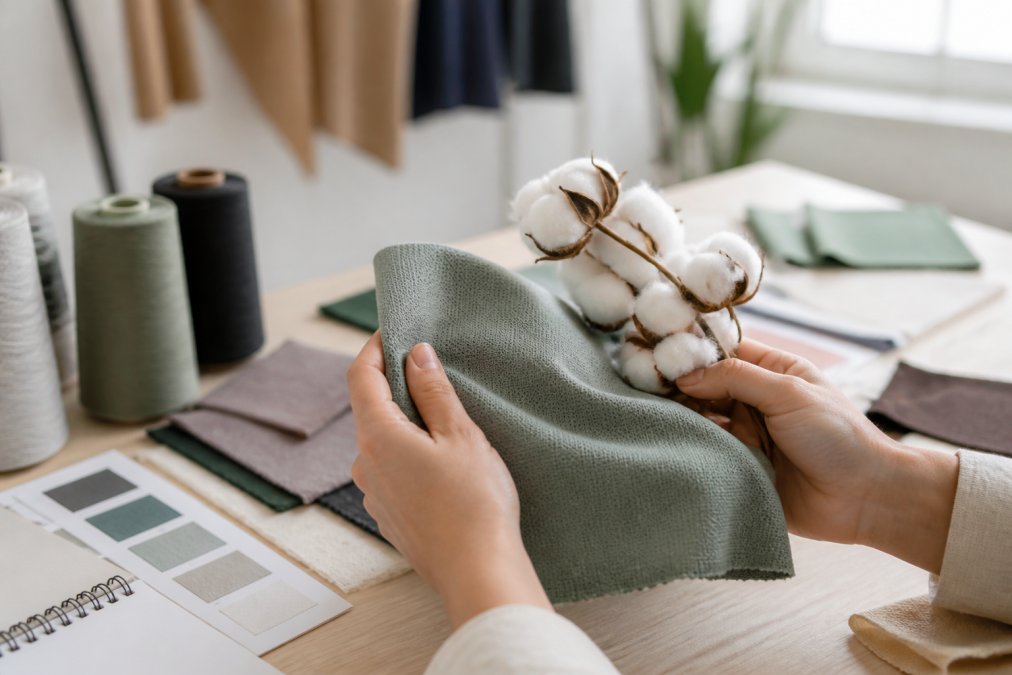
Recycled Polyester (rPET) vs. Organic Cotton vs. Tencel Modal
Recycled polyester (rPET) is plastic waste, most commonly PET bottles, melted and re-spun into yarn. It performs well for moisture-wicking and compression gear because the polymer behaves like virgin polyester: it moves sweat, holds shape, and dries fast. The trade-offs are real. rPET still sheds microfibers in the wash, and it is not biodegradable, so it persists in landfills for generations. Mechanical recycling also shortens the fiber over repeated cycles, which is why some rPET fabrics pill faster than virgin polyester.
Organic cotton is grown without synthetic pesticides or genetically modified seed, and it is verified through the USDA National Organic Program or GOTS. It is soft, breathable, and comfortable for low-impact wear like yoga, walking, and everyday layers. The drawbacks: cotton is a thirsty crop, it dries slowly, and it loses shape under heavy sweat. For high-intensity training, organic cotton is a comfort choice, not a performance one.
Tencel modal (and its sibling Tencel lyocell) comes from wood pulp processed in a closed-loop system that recaptures more than 99% of the solvent, according to the manufacturer Lenzing. The result is a fiber that is softer than cotton, drapes well, and breathes. It is excellent for base layers and recovery wear. It is not a performance fabric, it has lower abrasion resistance than polyester, so it will not survive the same number of high-friction training cycles.
How to Read a Fiber Label Without Getting Fooled
A fiber label tells you what the garment is made of, not how it was made. Two tops can both say "88% recycled polyester, 12% spandex" and have wildly different footprints depending on the factory, the dye process, and the energy source. Use the label as a starting point, then look for the certification that backs it:
- GOTS for organic cotton and other organic fibers
- bluesign for chemical and dye safety in synthetic production
- OEKO-TEX Standard 100 for tested non-toxic finishes
- FSC for wood-pulp fibers like Tencel modal
Materials to Avoid
- Conventional polyester from virgin petroleum, no recycled content, no chemical certification, and the same microfiber shedding problem as rPET without the waste-reduction benefit.
- Bamboo viscose processed with harsh solvents, the fiber source is renewable, but the conventional viscose process uses carbon disulfide, a toxic solvent.
The Fiber Trade-Off Table
| Fiber | Best For | Main Strength | Main Weakness |
|---|---|---|---|
| rPET | Training tops, compression | Moisture-wicking, durable | Sheds microfibers, not biodegradable |
| Organic cotton | Yoga, everyday wear | Soft, breathable, pesticide-free | Thirsty crop, dries slowly |
| Tencel modal | Base layers, recovery wear | Closed-loop, very soft | Lower abrasion resistance |
| Tencel lyocell | Breathable activewear | Closed-loop, stronger than modal | Pricier than cotton |
| Merino wool | Temperature-regulating layers | Odor-resistant, renewable | Expensive, delicate wash |
How to Spot Greenwashing: 7 Red Flags in Activewear Marketing
Greenwashing is marketing that implies environmental responsibility without verifiable evidence.
Elite Standard Vegan Protein (Vanilla) →
The 7 Red Flags
- Vague terms with no certification named. "Eco-friendly," "planet-positive," "conscious," and "green" are not regulated terms.
The 10-Minute Verification Workflow
- Find the certification name on the product page. Not the brand page, the product page. If there is no certification named, stop here.
- Search the certifier's public registry. GOTS, bluesign, OEKO-TEX, Fair Trade Certified, and B Corp all publish searchable lists of certified facilities and companies. If the brand is not in the registry, the claim does not hold.
- Check the factory list. Look for a "supply chain" or "our factories" page. If it does not exist, that is a signal.
- Read the materials percentage. "Recycled polyester" without a percentage is a marketing phrase. "88% recycled polyester (GRS-certified)" is a claim you can verify.
- Email the brand one specific question. Ask: "Which third-party certification does this specific product hold, and what is the recycled content percentage?" A vague reply is your answer.
What the FTC Actually Requires
The One-Question Test
If you only remember one thing from this section, remember this: ask the brand for the certification name and the recycled or organic content percentage for the specific product you are buying.
Ethical Activewear Certifications That Actually Matter
- GOTS for organic fiber content
- bluesign for chemical and dye safety
- Fair Trade Certified for ethical labor practices
- OEKO-TEX Standard 100 for tested non-toxic dyes and finishes
- B Corp for overall social responsibility
Step-by-Step: How to Choose Sustainable Activewear Brands
Use this process to evaluate any brand before you spend money.
Step 1: Audit Your Current Wardrobe
Count what you already own and how often you wear it.
Step 2: Check Certifications and Supply Chain Transparency
Look for a published factory list and at least one named third-party certification.
Step 3: Evaluate Cost-Per-Wear and Performance Testing
Beyond the Buy: Microplastic Shedding and End-of-Life Management
Microplastic shedding is the release of tiny synthetic fibers during washing, and it is the hidden cost of rPET and conventional polyester.
Conclusion: Building a Capsule Wardrobe That Performs and Lasts
The challenge is not finding sustainable activewear; it is resisting the urge to buy more than you need.
Frequently Asked Questions
What criteria define a sustainable activewear brand?
A sustainable activewear brand meets five core criteria: it uses eco-friendly materials like recycled polyester (rPET) or organic cotton, ensures ethical labor practices through fair wages and safe conditions, designs durable garments that resist pilling and stretching, avoids non-toxic dyes and finishes, and offers end-of-life solutions like recycling or take-back programs. Look for third-party certifications such as Fair Trade Certified or bluesign to verify these claims independently.
How can I tell if an activewear brand is greenwashing?
Spot greenwashing by checking for vague terms like 'eco-friendly' without specific data, missing third-party certifications, and a lack of supply chain transparency. If a brand claims to be sustainable but cannot show where its fabrics come from or how workers are treated, treat it as a red flag. Also, be wary of brands that highlight one green initiative while ignoring the environmental impact of their overall production.
What are the most eco-friendly fabrics for workout clothes?
The most eco-friendly fabrics for activewear include recycled polyester (rPET), organic cotton, and Tencel modal. Recycled polyester reduces plastic waste and has a lower carbon footprint than virgin polyester. Organic cotton avoids harmful pesticides, while Tencel modal is made from sustainably sourced wood pulp in a closed-loop process. Each fabric has trade-offs in moisture-wicking and durability, so choose based on your activity and care routine.
How do I verify a brand's ethical labor claims?
Verify ethical labor claims by looking for third-party certifications like Fair Trade Certified, which require independent audits of factories. Check the brand's website for a supplier list or transparency report. If a brand is vague about where its clothes are made or refuses to disclose factory names, that is a warning sign.