

Table of Contents
- Why Caffeine-Free Pre-Workout Fits Late Night Training
- How to Pick the Best Caffeine-Free Pre-Workout
- Caffeine-Free Pre-Workout Ingredients That Do the Work
- Pre-Workout for Evening Workouts: Timing and Sleep
- Pump Pre-Workout Without Stimulants: What to Expect
- Side Effects, Interactions, and Who Should Skip It
- Common Mistakes When Buying Stimulant-Free Pre-Workout
- Conclusion: Choosing for Your Training and Your Sleep
- Frequently Asked Questions
Last Updated: October 8, 2026
Why Caffeine-Free Pre-Workout Fits Late Night Training
A caffeine-free pre-workout for late night training solves a problem that stimulant formulas cannot: it supports energy, focus, and blood flow without the wired feeling that keeps you staring at the ceiling at midnight.
Caffeine's half-life is the reason. A meaningful portion of the caffeine you take at 8 p.m. is still circulating at 2 a.m., which is why late sessions and good sleep so often collide.
This guide from Peakform Nutrition covers how to read a non-stim pre-workout label, which ingredients actually do the work, how to time your serving, and which mistakes waste your money.
Caffeine-Free vs. Stimulant-Free: What the Label Actually Means
Caffeine-free means the product contains no caffeine. Stimulant-free is broader: the formula contains no caffeine and no other nervous-system stimulants, such as yohimbine or synephrine.
Those two claims are not interchangeable. A powder can be labeled caffeine-free while still carrying a stimulant that disrupts sleep or triggers jitters. For late-night training, stimulant-free is the safer standard.
Check the "other ingredients" panel, not just the front of the tub. Look for hidden caffeine sources like green tea extract or guarana, and for stimulants like yohimbine that some "non-stim" products still include. If a label lists an ingredient you cannot identify, look it up before you buy.
How to Pick the Best Caffeine-Free Pre-Workout
The best caffeine-free pre-workout is the one that fully discloses its doses, avoids hidden stimulants, and matches your training goal. Three criteria separate a trustworthy formula from a marketing label.
Selection Criteria: Doses, Testing, and Serving Size
Fully disclosed doses. A label that lists "proprietary blend" without amounts tells you nothing about whether the formula works. Look for exact gram amounts per ingredient.
Independent testing. Third-party testing confirms that what's on the label is in the tub. This matters if you have been burned by brands that claim "natural" but hide undeclared ingredients.
Realistic serving size. Compare the number of servings to the price. A cheap tub with 15 servings can cost more per workout than a premium one with 30.
| Criterion | What to Look For | Red Flag |
|---|---|---|
| Dose transparency | Exact grams per ingredient | "Proprietary blend" with no amounts |
| Testing | Third-party tested | No testing mentioned |
| Stimulant check | Zero caffeine and zero yohimbine | "Caffeine-free" only, stimulants unlisted |
| Serving size | 25-30 servings per tub | Fewer than 20 servings |
| Price per serving | Divide price by servings | High price, low serving count |
At Peakform Nutrition, our Ambrosia Pre-Workout Powder is built around this standard: lower levels of caffeine and high levels of nootropics, and five different Nitric Oxide ingredients for a long-lasting muscle pump.

Caffeine-Free Pre-Workout Ingredients That Do the Work
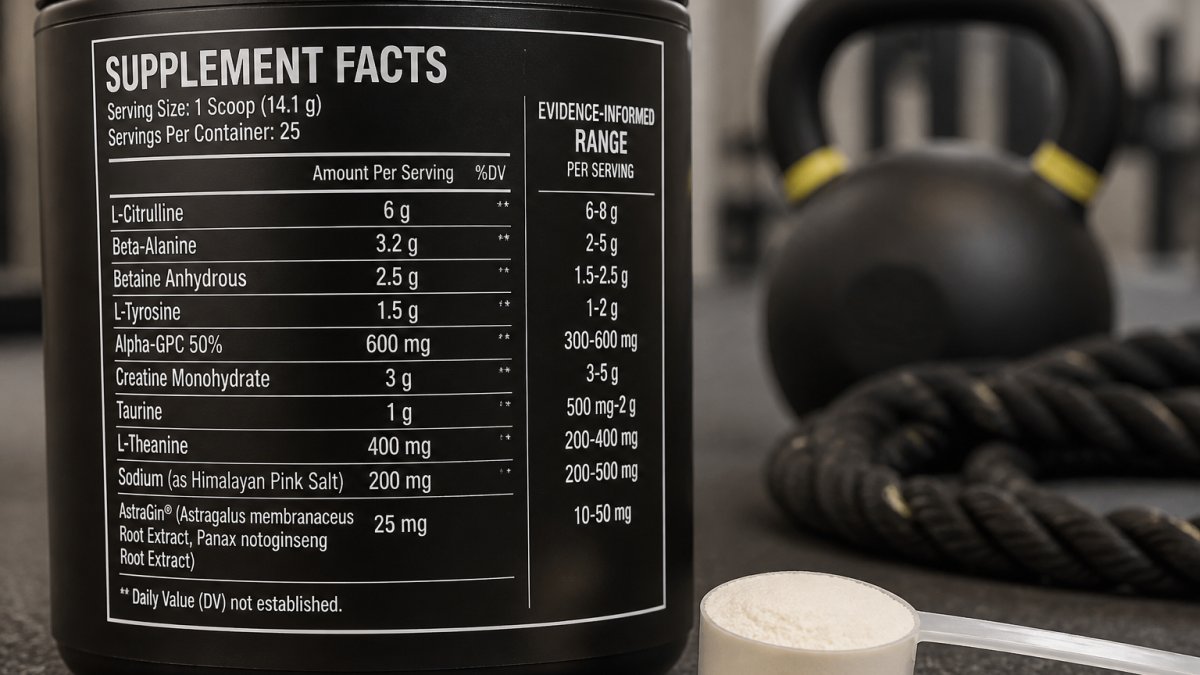
Most stimulant-free formulas use the same short list of ingredients. What separates a formula that works from one that does nothing is the dose, not the ingredient name. Below is what each compound is intended to do, the evidence-informed range practitioners commonly cite, and the label traps that hide underdosing.
Pump and Blood Flow
L-citrulline and citrulline malate. These raise nitric oxide, which widens blood vessels and drives the muscle pump. L-citrulline is the more concentrated form; citrulline malate is bound to malic acid and is heavier by weight.
Beta-alanine. This buffers acid in working muscle and supports capacity over longer sets and intervals.
Betaine anhydrous. Often included for training capacity and hydration support. A commonly cited range is about 2.5 g per day, and like beta-alanine it is a saturation ingredient rather than a pre-workout spike.
Focus and Mental Performance
L-tyrosine. A precursor to catecholamines, used for focus under fatigue or stress. Evidence-informed ranges commonly cited run from about 500 mg up to 2 g, taken 30-60 minutes pre-training. It is not a stimulant, but it can feel activating in some people.
Lion's Mane and other nootropic extracts. These are popular in stimulant-free formulas for mental clarity, but human performance data is thinner than for the pump and endurance compounds. Treat them as supporting players, not the reason to buy.
Taurine and DMAE. Taurine supports hydration and workout capacity; DMAE is included for mental clarity. Both are typically dosed in the hundreds of milligrams to low grams.
Endurance and Recovery
Taurine and betaine overlap with the pump and capacity groups and are often counted twice on marketing panels. Beta-alanine is the main endurance compound, and its soreness-reduction effect comes from the same buffering mechanism, not a separate benefit.
How to Read the Panel
A trustworthy label lists exact gram amounts per ingredient. A "proprietary blend" hides the doses, which usually means at least one ingredient is underdosed. Compare the listed amount to the evidence-informed range above, then check the serving size: a formula that splits a 6 g citrulline dose across two scoops is really a 3 g dose per workout.
Pre-Workout for Evening Workouts: Timing and Sleep
Timing a pre-workout for evening workouts comes down to one rule: take it 15-30 minutes before training, and finish your session at least two to three hours before bed. That window lets your body settle before sleep.
Sleep quality is where late training gets tricky. Even without caffeine, an intense session raises core body temperature and adrenaline, both of which delay sleep onset.
Practical sleep guidance for late trainers:
- Finish training 2-3 hours before bed when possible
- Take your serving 15-30 minutes pre-training, not later
- Keep the post-workout cooldown calm: low light, slow breathing
- Avoid screens for the last 30 minutes before sleep
The CDC guidance on sleep and health notes that consistent sleep timing supports recovery and performance. Late trainers who protect their sleep window get more from every session.
Pump Pre-Workout Without Stimulants: What to Expect
A pump pre-workout without stimulants delivers blood flow and focus, not a rush. Expect a gradual onset rather than a spike, a fuller muscle feel during training, and no crash afterward.
The difference is the mechanism. Stimulants push the nervous system; nitric oxide ingredients widen blood vessels. That means the pump and endurance benefits arrive without the jitters, racing heart, or tingling that turn many people off standard pre-workouts.
What you will notice:
- A steady focus that lasts through the session
- Fuller muscles during and after training
- No post-workout crash
- No tingling sensation if the formula skips high-dose beta-alanine
If you have tried several pre-workouts and disliked the jitters, a stimulant-free formula is the fix.
Side Effects, Interactions, and Who Should Skip It
Stimulant-free formulas have fewer side effects than caffeinated ones, but "stimulant-free" is not the same as "risk-free." The ingredients that do the work are also the ones that cause most of the complaints, and the dose usually determines whether you notice them.
Common Side Effects and What Drives Them
Tingling (paresthesia). Caused by beta-alanine, and it is dose-dependent. A single 3.2 g dose commonly produces tingling within 15-30 minutes; splitting the dose across the day or using a sustained-release version reduces it.
Gastrointestinal upset. Citrulline, betaine, and sugar alcohols used for flavoring can cause bloating or loose stools, especially when taken on an empty stomach or with a large volume of water.
Blood pressure changes. Nitric oxide boosters widen blood vessels and can lower blood pressure. This is usually mild, but it matters if you already take blood pressure medication or have low blood pressure.
Activation or anxiety. L-tyrosine and yohimbine can feel activating.
Caffeine-Free vs. Stimulant-Free: A Safety Distinction
A caffeine-free product contains no caffeine. A stimulant-free product contains no caffeine and no other nervous-system stimulants, such as yohimbine, synephrine, or high-dose green tea extract. For late-night training, stimulant-free is the safer standard because the goal is to avoid anything that raises heart rate or delays sleep. Check the "other ingredients" panel, not just the front of the tub.
Who Should Talk to a Clinician First
Talk to a healthcare provider before starting any supplement if you:
- Take prescription medication, especially for blood pressure, anxiety, or a heart condition
- Have a history of arrhythmia, low blood pressure, or anxiety disorders
- Are pregnant or nursing
- Have kidney or liver conditions, since some ingredients are cleared by those organs
- Are sensitive to stimulants or have reacted poorly to pre-workouts before
Why Label Accuracy Varies
The FDA guidance on dietary supplements explains that supplements are regulated differently from drugs, so label accuracy is not guaranteed. Third-party testing is the practical way to confirm that what is on the label is in the tub, and it is the single best filter for avoiding undeclared stimulants.
Common Mistakes When Buying Stimulant-Free Pre-Workout
Most buying mistakes come down to trusting the front of the label instead of the back. Avoid these five traps.
- Confusing caffeine-free with stimulant-free. Check for yohimbine and synephrine, not just caffeine.
- Ignoring dose amounts. A named ingredient means nothing without a gram amount.
- Skipping the serving math. Divide price by servings to find the real cost per workout.
- Buying on flavor alone. Taste matters, but it does not tell you whether the formula works.
- Overlooking timing. Even a stimulant-free formula taken too close to bed can disrupt sleep.
Conclusion: Choosing for Your Training and Your Sleep
Late-night training forces a trade-off that most pre-workouts ignore: energy now or sleep later. A caffeine-free pre-workout for late night training lets you have both, provided you check the label for hidden stimulants, confirm the doses, and time your serving correctly.
At Peakform Nutrition, we built Ambrosia Pre-Workout Powder for exactly this situation.
If you train after dark and want to stop choosing between performance and sleep, our team can help you find the right fit. Get started with Peakform Nutrition and train hard without paying for it at 2 a.m.
Frequently Asked Questions
Can I take pre-workout late at night?
Yes, if it is caffeine-free. A caffeine-free pre-workout for late night training delivers pump, focus, and endurance support without the stimulant that keeps you awake. Check the label for hidden caffeine sources like green tea extract or guarana, since those can still disrupt sleep even when the front of the tub says 'non-stim.' If your formula is truly stimulant-free, you can take it 15 to 30 minutes before training and still wind down normally afterward.
What ingredients should I look for in a caffeine-free pre-workout?
Start with pump and blood-flow ingredients such as L-citrulline or citrulline malate, plus nitric oxide compounds. For focus, look for L-tyrosine, taurine, Lion's Mane, or DMAE. For endurance and reduced soreness, beta-alanine and betaine anhydrous are common. Check that doses are disclosed on the label, not hidden in a proprietary blend, so you know how much of each active ingredient you are actually getting per serving.
Will a caffeine-free pre-workout affect sleep?
It should not, because there is no caffeine to block adenosine and delay sleep onset. The main sleep risk with evening training is the workout itself, which raises core body temperature and heart rate. Finish training at least 90 minutes before bed, keep the room cool and dark, and avoid screens during your cooldown. If you are stimulant-sensitive or deal with anxiety, a stimulant-free formula removes the jitters and racing-heart feeling that can keep you lying awake.
Can a caffeine-free pre-workout still improve workout performance?
Yes. Caffeine is one performance lever, but it is not the only one. Citrulline supports blood flow and muscle pump, beta-alanine buffers acid buildup to extend training capacity, and nootropics like L-tyrosine support focus and mental performance. Many athletes report a cleaner energy feel without the crash that follows a high-caffeine scoop. If you train at night and want to protect sleep quality, a caffeine-free formula can support the session without costing you recovery.
These statements have not been evaluated by the Food and Drug Administration. This product is not intended to diagnose, treat, cure, or prevent any disease. Consult a healthcare provider before starting any supplement.