

Table of Contents
- What Actually Makes Skin Glow
- Quick Comparison: The 10 Best Natural Supplements for Glowing Skin
- 1. Collagen Peptides: The Building Block for Skin Elasticity
- 2. Vitamin C: Collagen Synthesis and Antioxidant Protection
- 3. Vitamin A (Retinol): Cellular Regeneration and Skin Turnover
- 4. Vitamin E: Fat-Soluble Antioxidant for Free Radical Damage
- 5. Omega-3 Fatty Acids: Dermal Hydration From Within
- 6. Zinc: Best Supplements for Acne-Prone Skin and Inflammation Reduction
- How to Choose and Combine These Supplements
- Frequently Asked Questions
Last Updated: September 30, 2026
What Actually Makes Skin Glow
Glowing skin reflects healthy barrier function, steady collagen synthesis, and controlled oxidative stress, not one miracle ingredient. At Peakform Nutrition, we treat skin health as a nutrition problem first: the 10 best natural supplements for glowing skin supply micronutrients your skin already uses to repair itself.
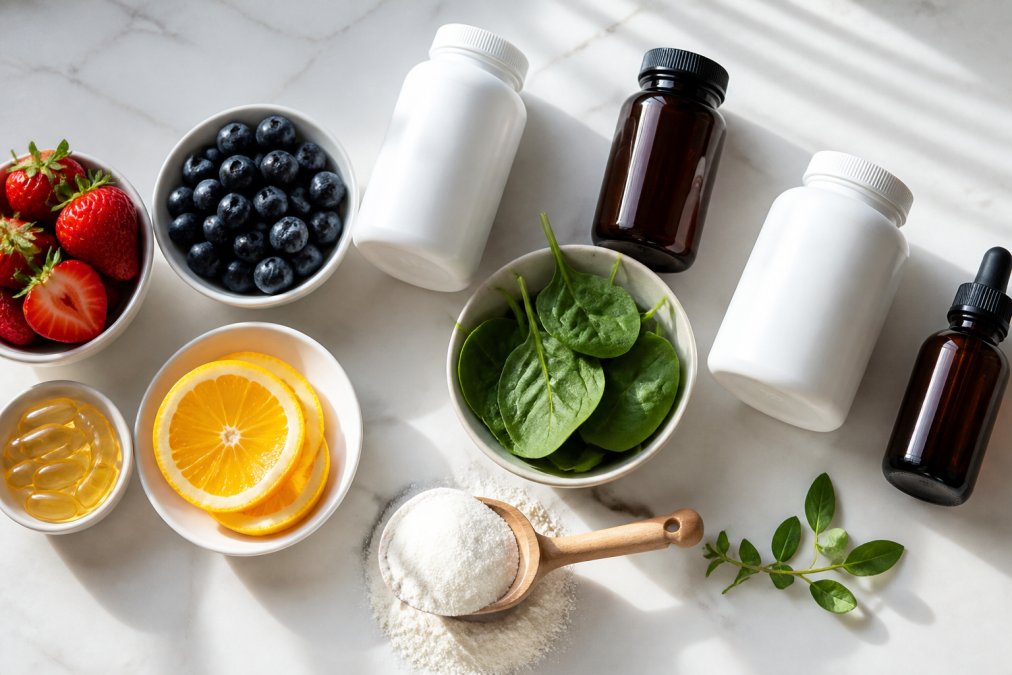
Quick Comparison: The 10 Best Natural Supplements for Glowing Skin
The strongest options combine collagen support, antioxidant protection, and barrier hydration. Here's how the ten compare.
| Supplement | Primary Benefit | Best For | Typical Form |
|---|---|---|---|
| Collagen peptides | Skin elasticity, dermal matrix | Aging skin, joint support | Powder |
| Vitamin C | Collagen synthesis, antioxidant | Most adults | Capsule, gummy |
| Vitamin A (Retinol) | Cellular regeneration | Uneven texture | Capsule |
| Vitamin E | Free radical damage defense | Dry, stressed skin | Capsule |
| Omega-3 fatty acids | Dermal hydration, lipid barrier | Dry skin, inflammation | Softgel |
| Zinc | Acne management, inflammation | Acne-prone skin | Capsule |
| Probiotics | Skin microbiome, gut-skin axis | Reactive skin | Capsule |
| Selenium | UV-induced damage support | Sun-exposed skin | Capsule |
| Vitamin D | Skin turnover, immune balance | Low-sun climates | Capsule |
| Resveratrol | Antioxidant, anti-aging support | Mature skin | Capsule |
1. Collagen Peptides: The Building Block for Skin Elasticity
Collagen peptides are the most direct supplement for skin elasticity because they supply the amino acids your body uses to rebuild the dermal matrix. Collagen is one of the body's most abundant proteins, and natural production declines with age, the same decades in which fine lines and sagging appear.
Why Hydrolyzed Collagen Absorbs Better
Hydrolyzed collagen absorbs more readily than intact collagen because the peptides are already broken into smaller fragments, and your body can only use what it absorbs. Taste and mixability are where most powders fall short, and that usually decides whether you stick with it for the months collagen needs.
Peptide Size, Dose, and What the Research Actually Shows
The word "hydrolyzed" alone tells you almost nothing. What matters is peptide molecular weight in daltons: most clinical work uses roughly 2,000 to 5,000 daltons, because fragments in that window survive digestion and reach the bloodstream as collagen-derived dipeptides and tripeptides. A powder listing "collagen peptides" without a molecular weight or hydrolysis spec asks you to take the manufacturer's word for it.
Pair It With Vitamin C and Protein
Collagen synthesis is enzymatic, and two cofactors matter more than any label claim:
- Vitamin C is required for the hydroxylation steps that stabilize the collagen triple helix. Taking collagen without it is like shipping bricks to a job site with no mortar.
- Total dietary protein supplies the amino acids collagen peptides lack. Collagen is incomplete, low in tryptophan and several essential amino acids, so it works alongside a protein-adequate diet, not as a replacement.
Sourcing and Sustainability: The Question Most Guides Skip
Collagen is an animal byproduct, so sourcing is part of the story. Bovine collagen comes from hides and connective tissue, marine from fish skin and scales, and some products use eggshell membrane, each with a different footprint and supply chain.
A few practical things to look for:
- Species and origin disclosure. "Grass-fed" and "pasture-raised" mean something only when the label names the source and certification. Look for third-party certifications, not front-of-package adjectives.
- Marine collagen and bycatch. Marine collagen is sustainable only if the fish skin is a byproduct of an existing fishery rather than dedicated harvesting. Byproduct streams are lower impact.
- Heavy metal testing. Fish-derived collagen should carry a certificate of analysis for heavy metals, since fish skin can concentrate contaminants.
- Third-party testing generally. NSF Certified for Sport, Informed Sport, and USP verification show a product was independently screened for contaminants and, sometimes, label accuracy.
2. Vitamin C: Collagen Synthesis and Antioxidant Protection
Vitamin C is required for collagen synthesis and doubles as a water-soluble antioxidant against free radical damage. Without it, your body cannot properly cross-link collagen, no matter how much you consume.
How Vitamin C Works With Your Skin Barrier
Vitamin C supports the skin barrier by neutralizing oxidative stress in the outer layers and helps recycle vitamin E, which is why the two work better together.
3. Vitamin A (Retinol): Cellular Regeneration and Skin Turnover
Vitamin A drives cellular regeneration and normal skin turnover, which is why it appears in oral and topical forms. Retinol helps replace old skin cells with fresher ones, improving texture over time.
4. Vitamin E: Fat-Soluble Antioxidant for Free Radical Damage
Vitamin E is a fat-soluble antioxidant that protects cell membranes from free radical damage, including UV-induced damage, in the lipid portions of cells where water-soluble antioxidants cannot reach.
5. Omega-3 Fatty Acids: Dermal Hydration From Within
Omega-3 fatty acids support dermal hydration by strengthening the lipid barrier that holds moisture in. Dry, flaky skin often reflects a barrier problem, not just a surface one.
Aphrodite’s Blessing Anti-Aging Serum →
EPA vs. DHA: Two Fatty Acids, Two Jobs
"Omega-3" is a category, not an ingredient. The two marine omega-3s that matter for skin:
- EPA (eicosapentaenoic acid), the more anti-inflammatory of the two, most associated with calming reactive, redness-prone skin and modulating the inflammatory signaling behind acne.
- DHA (docosahexaenoic acid), a structural component of cell membranes, including skin cells, supporting membrane fluidity and barrier function.
Reading the Label: Total Omega-3 Is Not the Number That Matters
"1,000 mg fish oil" describes the capsule size, not the dose you want. What matters is combined EPA + DHA: a 1,000 mg softgel might hold 180 mg EPA and 120 mg DHA, 300 mg of the fatty acids you're buying, or 600 mg or more, depending on concentration.
Form Matters: Triglyceride vs. Ethyl Ester
Fish oil comes in two main forms:
- Triglyceride form (rTG or natural TG), the form found in fish, generally better absorbed and common in higher-quality products.
- Ethyl ester form (EE), processed for higher concentration per capsule, absorbed somewhat less efficiently on an empty stomach, though the gap narrows with a fat-containing meal.
Neither form is unsafe, but a concentrated ethyl ester product and a triglyceride product are not interchangeable gram-for-gram, and labels rarely make the distinction obvious.
Sourcing: Where the Oil Comes From Is Part of the Product
With fish oil, sourcing is not a footnote. Check:
- Small, short-lived fish. Anchovies, sardines, and mackerel sit lower on the food chain, accumulate fewer contaminants, and are more sustainably managed than large predatory fish.
- Third-party certifications. Look for the International Fish Oil Standards (IFOS) program or a USP or NSF mark, which verify oxidation levels, heavy metal content, and label accuracy, the three things most likely wrong in cheap fish oil.
- Oxidation. Rancid fish oil is a real problem. Capsules that smell strongly fishy or repeat on you often signal oxidation, not just potency. Refrigerate them.
- Algal oil as an alternative. For anyone avoiding fish, fermented algal DHA and EPA provide the same fatty acids without the fishery supply chain, pricier per gram, but it sidesteps both the sustainability question and the fishy aftertaste.
A Note on Interactions
Omega-3s have a mild blood-thinning effect at higher doses. If you take anticoagulant or antiplatelet medication or have surgery scheduled, talk to a clinician before a high-dose regimen, not a reason to avoid fish, but a reason to be deliberate about concentrated capsules.
6. Zinc: Best Supplements for Acne-Prone Skin and Inflammation Reduction
Zinc is one of the best supplements for acne-prone skin because it supports inflammation reduction and normal skin healing, plus immune function and the skin's oil balance.
How to Choose and Combine These Supplements
Start with nutrients that match your main concern, then build a simple routine rather than buying everything at once.
- Identify your primary concern: elasticity, acne, dryness, or dullness
- Choose one core supplement (collagen or a multivitamin) as your base
- Add one targeted nutrient (zinc for acne, omega-3 for dryness)
- Confirm vitamin C intake to support collagen synthesis
- Check for interactions with any topical retinol or acid you use
- Set a 90-day review point before judging results
Frequently Asked Questions
What is the best supplement for skin glow?
Collagen peptides and vitamin C rank among the most studied for skin radiance. Collagen provides the amino acids glycine, proline, and hydroxyproline that support collagen synthesis, while vitamin C is required for that process. Omega-3 fatty acids support dermal hydration and the lipid barrier. A multivitamin covering zinc, selenium, and vitamins A and E fills micronutrient gaps that affect complexion health. Most dermatologists suggest starting with one or two targeted supplements rather than a dozen at once.
How long does it take to see results from skin supplements?
Skin cell turnover takes roughly 28 days in younger adults and longer with age, so most supplements need 8 to 12 weeks of consistent use before visible changes appear. Collagen peptides for skin elasticity typically show measurable differences in clinical trials after 8 to 12 weeks. Vitamin C and zinc may affect inflammation and skin texture sooner, within 4 to 6 weeks. Take them daily with food, and photograph your skin monthly to track real progress rather than relying on memory.
Are skin supplements regulated by the FDA?
The FDA regulates dietary supplements as a category of food, not as drugs. That means manufacturers are responsible for ensuring safety and label accuracy before products reach shelves, but the FDA does not approve supplements for effectiveness beforehand. Third-party testing seals and clear ingredient labels help verify quality. If a supplement claims to treat or cure a skin condition, that crosses into drug territory and is not permitted under FDA rules.
What are the best supplements for acne-prone skin?
Zinc is the most studied mineral for acne management, with research showing it can reduce inflammatory lesions. Omega-3 fatty acids support inflammation reduction, and probiotics may influence the skin-gut axis and skin microbiome balance. Vitamin A supports skin turnover, which helps prevent clogged pores. Avoid high-dose vitamin B12 and iodine unless a doctor recommends them, since both have been linked to acne flare-ups in some people.
Can I take skin supplements alongside retinol serums and other topicals?
Yes, but timing matters. Oral vitamin A and topical retinol both increase skin turnover, so combining high doses can cause irritation. Vitamin C supplements pair well with topical vitamin C, but keep total intake under 2,000 mg daily to avoid digestive upset. If you use prescription retinoids, ask your dermatologist before adding a high-dose vitamin A supplement. Always apply SPF when using retinol topically, since it increases UV sensitivity.
Building glowing skin takes consistency, and the right nutrients in absorbable forms do most of the work. Peakform Nutrition makes that simpler with clean formulas built around real bioavailability: grass-fed collagen peptides, an Elite Multivitamin with vitamin C, E, zinc, and selenium, and the Aphrodite's Blessing line for topical support. Get started with Peakform Nutrition and build a routine that supports your skin from the inside out.