

Table of Contents
- Why Supplement Ingredient Labeling Matters for Your Health
- How to Read Supplement Facts Labels
- Proprietary Blend Supplement Risks and Transparency
- Understanding FDA Labeling Requirements and Mandatory Disclosures
- Third-Party Supplement Testing: Verifying What's Really Inside
- Red Flags That Signal Deceptive Labeling Practices
- Allergen Labeling and Supply Chain Traceability
- Conclusion
Last Updated: August 22, 2026
Why Supplement Ingredient Labeling Matters for Your Health
When you pick up a supplement bottle, that label is your only window into what's actually inside. Yet most people scan it briefly and move on. The reality is that supplement ingredient labeling directly impacts whether you're getting what you paid for, or something far less effective, or even potentially harmful.
Supplement ingredient labeling isn't just regulatory compliance, it's your protection. The FDA requires certain disclosures, but many brands exploit the gaps in those requirements (the FDA). Proprietary blends hide ingredient doses. Vague ingredient lists obscure what you're really consuming. Without understanding how to read these labels, you're making purchasing decisions blind.
This guide walks you through what matters on a supplement label, how to spot red flags, and what questions to ask before you buy. By the end, you'll know exactly what transparency looks like and how to demand it from the brands you trust with your health.
How to Read Supplement Facts Labels
The Supplement Facts panel is standardized by the FDA, which means every supplement label follows the same basic structure (the FDA). Your job is knowing what to look for.
Breaking Down Each Section
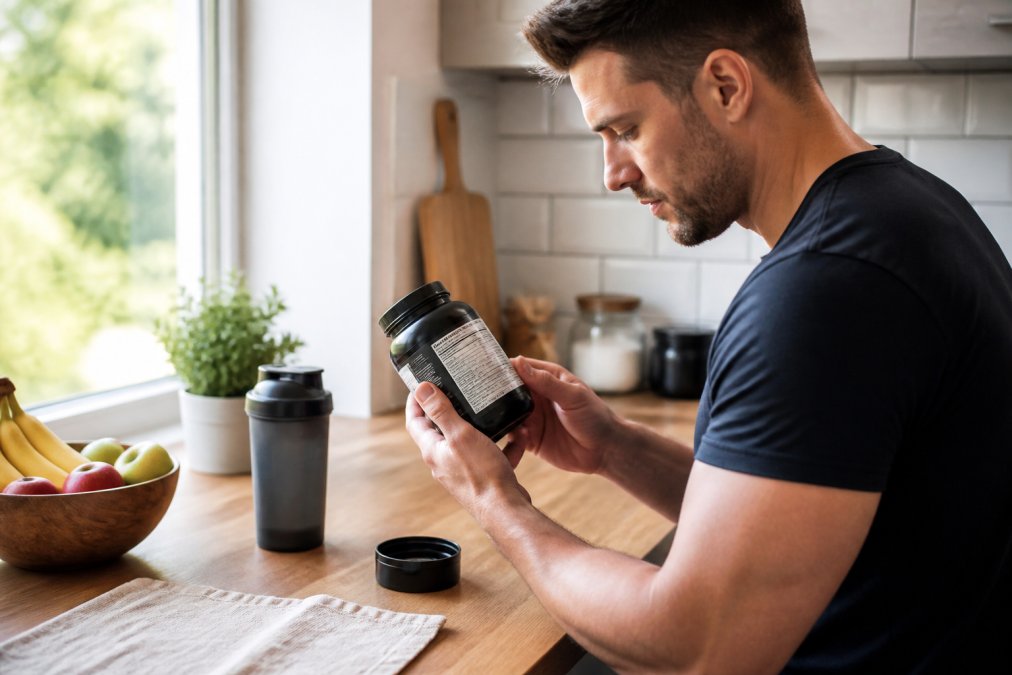
Start at the top with the serving size. This number determines everything else on the label. If a serving size is unusually small (like half a scoop when most people use a full scoop), the actual doses you're taking are higher than what's listed. This is a common tactic to make ingredient quantities look more impressive than they are in real use.
Below serving size comes the active ingredients list. Each ingredient should list its quantity in milligrams (mg), grams (g), or international units (IU). This specificity matters enormously. "Contains vitamin C" tells you nothing useful. "Contains 500mg vitamin C" tells you whether you're getting a meaningful dose.
The percentage Daily Value (%DV) appears next to some ingredients. For nutrients like vitamin D or calcium, this percentage is helpful context. For herbal extracts or amino acids, there may be no established Daily Value, so that column stays blank. That's normal.
Non-medicinal ingredients come next: fillers, binders, flow agents, and preservatives. They're not active ingredients, but they matter for people with sensitivities. The order matters too, ingredients are listed by weight, heaviest first. If a binder appears before the active ingredient, that formula is mostly filler.
Identifying Active vs. Non-Medicinal Ingredients
Active ingredients are the compounds with documented effects on your body: amino acids, vitamins, minerals, herbal extracts. Non-medicinal ingredients are everything else: the cellulose that holds a tablet together, the silicon dioxide that prevents clumping.
A supplement with 2g of active ingredient and 8g of fillers is very different from one with 8g of active ingredient and 2g of fillers. Both might cost the same, but one is 80% filler. Most consumers can't tell the difference without reading the label carefully.
Some non-medicinal ingredients matter for specific populations. Magnesium stearate is widely used and generally recognized as safe. Titanium dioxide has been studied for potential health effects. Carrageenan, a common thickener, triggers digestive issues in sensitive individuals. These aren't "bad" ingredients, they're just worth knowing about if you have sensitivities.
A supplement might contain no tree nuts as an active ingredient but be processed in a facility with tree nuts. That disclosure should appear clearly, usually at the bottom of the label or in a separate allergen statement.
Proprietary Blend Supplement Risks and Transparency
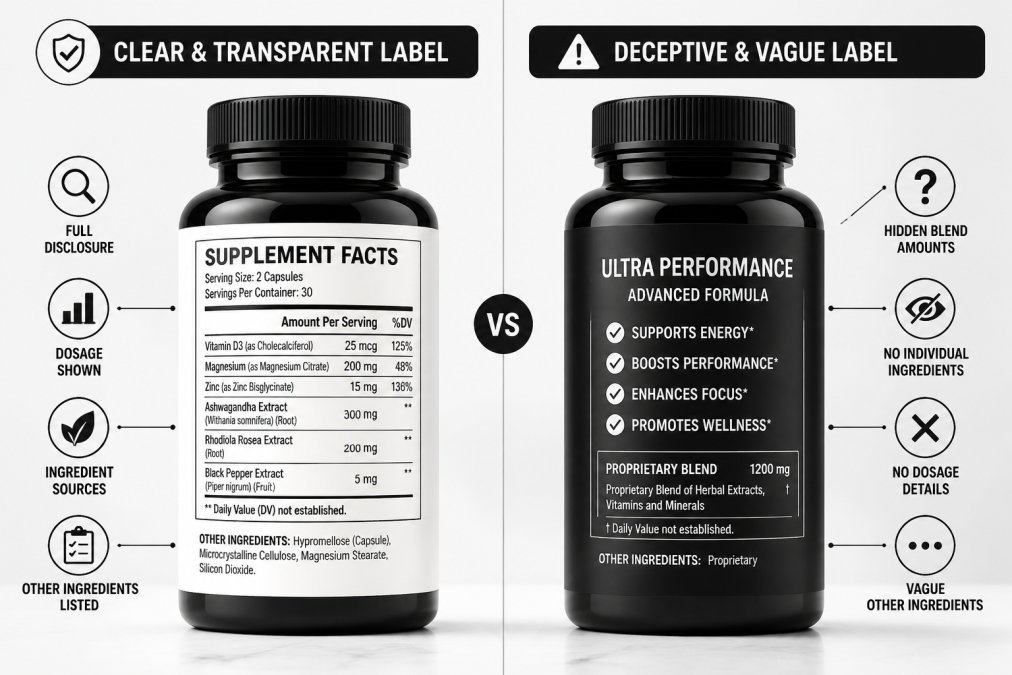
Proprietary blends are the supplement industry's favorite way to hide information while staying technically legal. A proprietary blend lists ingredients by name but not by individual quantity. Instead of seeing "100mg ingredient A, 50mg ingredient B, 25mg ingredient C," you see "Proprietary Blend (175mg total): ingredient A, ingredient B, ingredient C."
This matters because you have no idea what percentage of that 175mg is actually ingredient A versus the others. The company could be using 150mg of a cheap filler and 25mg of the expensive active compound. You'd never know. This is why proprietary blends are a major red flag in supplement ingredient labeling.
If a brand won't disclose individual ingredient quantities, ask yourself why. Transparency builds trust. Opacity suggests something to hide. Use the total blend weight as a baseline. A 2g proprietary blend might be reasonable. A 500mg proprietary blend of five ingredients is almost certainly underdosed. If you divide the total blend weight by the number of ingredients, you get the average dose per ingredient. If that average is lower than what scientific research suggests is effective, the formula is weak.
Peakform Nutrition's approach to ingredient transparency means listing every active compound with its exact dose. No hiding behind proprietary blends. No guessing about what you're actually consuming.
Understanding FDA Labeling Requirements and Mandatory Disclosures
The FDA regulates dietary supplements differently than drugs (the FDA). Supplements can't claim to treat, cure, or prevent disease, that would make them drugs. But they can claim to "support" health, "promote" wellness, or "maintain" function. This language matters legally and practically.
What Must Appear on Every Label
Every supplement label must contain specific mandatory elements: the product name, the statement "Dietary Supplement" or "Supplement Facts" panel, the net quantity, and the manufacturer, packer, or distributor name and address. The Supplement Facts panel must list serving size, servings per container, and all dietary ingredients with their quantities in descending order by weight.
Certain disclosures are mandatory based on what the product contains. If a supplement includes caffeine, which can interact with certain medications, that information should be disclosed. If the supplement could trigger an allergic reaction, allergen information must be clear. Warnings and cautions are mandatory when appropriate. Pregnant women shouldn't take certain supplements. People on blood thinners need to avoid others.
The FDA Disclaimer and What It Actually Means
Almost every supplement label includes: "These statements have not been evaluated by the Food and Drug Administration. This product is not intended to diagnose, treat, cure, or prevent any disease."
This disclaimer is mandatory for all dietary supplements. It's not optional, and its presence doesn't indicate a problem. It's simply the legal boundary between supplements and drugs. Supplements can support health; they can't claim to treat conditions.
What the disclaimer actually means is that the FDA hasn't reviewed the specific health claims made on the label the way it reviews drug claims. The FDA does oversee supplement safety and labeling accuracy, but it doesn't pre-approve supplements the way it approves medications. This creates a different risk profile. Supplements are generally safer to experiment with, but you have less regulatory assurance about their efficacy.
The disclaimer doesn't mean the supplement is ineffective. It means the company can't claim it treats a disease. A supplement that supports cardiovascular health is fine. A supplement that claims to treat heart disease crosses into drug territory and violates FDA regulations.
Third-Party Supplement Testing: Verifying What's Really Inside
Supplement ingredient labeling tells you what the company claims is in the bottle. Third-party testing tells you what's actually there. These aren't always the same thing.
Third-party testing means an independent laboratory, not the manufacturer, tests the product for ingredient accuracy, purity, and contamination. They verify that the label's claims match reality. They test for heavy metals, microbial contamination, and banned substances.
Not all supplements undergo third-party testing. It's expensive, which is why many budget brands skip it. But if a brand claims transparency and doesn't get third-party testing, that's a contradiction. Several third-party testing organizations exist: NSF International, USP (United States Pharmacopeia), and ConsumerLab are the most recognized. Products that pass their testing display a certification mark on the label.
Look for testing that includes heavy metal screening. Lead, cadmium, and arsenic can accumulate in some herbal supplements. A reputable brand tests for these. Look for microbial testing too, E. coli and Salmonella contamination in supplements, while rare, does happen. Third-party testing catches it.
The cost of third-party testing is real, and companies that do it often charge more. But that premium reflects actual verification. You're not just trusting the manufacturer's word; you're buying products that have been independently confirmed.
Red Flags That Signal Deceptive Labeling Practices
Certain patterns on supplement labels should make you pause. Proprietary blends are the obvious first flag. Vague ingredient names like "herbal blend" or "botanical complex" tell you nothing. If the label doesn't specify which herbs or botanicals, the company is hiding something.
Dosages that seem too low compared to research are a red flag. If scientific studies show 500mg of an ingredient is the minimum effective dose, and the label lists 50mg, you're not getting a functional product.
Ingredient lists that don't match the marketing claims are suspicious. A pre-workout claims to boost energy and focus but lists minimal caffeine and no nootropics? The formula doesn't support the claims.
Unrealistic claims are red flags. "Lose 10 pounds in a week" or "Build 10 pounds of muscle in a month" aren't achievable through supplementation alone. If the label makes promises that defy biology, the company is selling hype, not results.
Missing allergen information when allergens are likely is a serious red flag. If a supplement contains tree nuts, shellfish, or other common allergens, that must be clearly stated. If the label is silent on allergens but the ingredients suggest they might be present, contact the manufacturer and ask.
Prices that seem too good to be true usually are. A supplement that costs half the price of competitors with similar formulations might be using lower-quality ingredients, less effective forms, or smaller doses.
Allergen Labeling and Supply Chain Traceability
The FDA requires that major allergens, tree nuts, peanuts, shellfish, fish, milk, eggs, soy, wheat, sesame, be clearly disclosed on supplement labels. If a supplement contains an allergen as an active ingredient, it must be clearly labeled. "Contains shellfish-derived glucosamine" is the kind of disclosure you should see. If a supplement is manufactured in a facility with allergens but doesn't contain them as ingredients, the label might say "Manufactured in a facility that processes shellfish."
Some supplements don't disclose facility-based allergen risks, which is a gap in transparency. A person with a severe shellfish allergy needs to know if their supplement was made in a facility where shellfish dust might contaminate the product. If the label doesn't address this and you have a severe allergy, contact the manufacturer directly.
Supply chain traceability is the newer frontier in supplement transparency. Where did the ingredients come from? Were they sourced from verified suppliers? Brands that prioritize transparency often disclose supplier information or third-party verification of ingredient sourcing. This level of openness is rare but increasingly expected by informed consumers.
Peakform Nutrition's commitment to clean, effective ingredients extends to sourcing and verification. Knowing where ingredients come from and how they're tested before formulation is part of what transparency in supplement ingredient labeling actually requires in practice.
Conclusion
Reading a supplement label correctly is a learnable skill that transforms how you shop. You move from trusting marketing claims to evaluating actual formulations. You spot weak dosages, hidden ingredients, and deceptive practices. You understand what FDA disclaimers mean and what third-party testing verifies.
Look for clear ingredient disclosure with specific quantities. Avoid proprietary blends. Prioritize third-party testing. Check allergen information carefully. Question claims that seem too good to be true.
When you're ready to upgrade your supplement routine with formulations built on genuine transparency, Peakform Nutrition delivers exactly what the label promises. Our pre-workout powders feature crystal-clear ingredient lists with exact doses, no proprietary blends, no hidden fillers. Shop Now to see the difference transparent formulation makes.
Frequently Asked Questions
What are the biggest red flags to look for on a supplement label?
Watch for vague ingredient lists, missing serving sizes, undisclosed proprietary blends without ingredient amounts, exaggerated health claims, and absence of third-party testing seals. Labels should list all active ingredients with exact dosages, include allergen warnings, and display manufacturer contact information. If a brand won't disclose what's inside or makes medical claims (like 'cures' or 'treats'), that's a serious warning sign that the product lacks transparency and regulatory compliance.
How can I verify the quality of supplement ingredients through labeling?
Check for third-party testing certifications like NSF Certified for Sport, USP, or ConsumerLab seals on the label. Examine the supplement facts panel for specific ingredient names and dosages rather than vague proprietary blends. Look for standardized extracts listed with their potency percentages. Verify the manufacturer's contact information and facility certifications. Brands committed to ingredient transparency will clearly state the source of raw materials and whether ingredients are tested for contaminants, heavy metals, and microbial safety.
What is the FDA disclaimer on supplement labels, and what does it actually mean?
The FDA requires a disclaimer stating: 'These statements have not been evaluated by the FDA. This product is not intended to diagnose, treat, cure, or prevent any disease.' This means the supplement hasn't undergone FDA approval like medications do. However, it doesn't mean the product is unsafe or ineffective, it means the company cannot make medical claims. The disclaimer protects consumers by clarifying that supplements are dietary products, not drugs, and that you should consult a healthcare provider for medical conditions. Legitimate brands display this prominently and honestly.
Why are proprietary blends problematic for supplement ingredient labeling transparency?
Proprietary blends allow manufacturers to hide exact ingredient amounts behind a single total weight, claiming trade secret protection. This prevents consumers from knowing whether a blend contains therapeutic doses or minimal fillers. You can't verify bioavailability or compare potency between brands. Transparent labeling lists every ingredient with its exact dosage, letting you make informed decisions and avoid underdosed products. Brands using proprietary blends often do so to obscure low-quality formulations or excessive fillers, making it impossible to assess real value or safety.