

Table of Contents
- What Collagen Peptides Actually Do for Skin Elasticity
- Quick Comparison: Collagen Peptides for Skin Elasticity
- The Best Collagen Type for Skin Health
- How Long to Take Collagen for Skin Elasticity
- What the Clinical Evidence Says About Collagen and Skin Firmness
- Dosage, Synergistic Ingredients, and Absorption
- Sourcing, Safety, and Side Effects
- Conclusion
- Frequently Asked Questions
Last Updated: September 15, 2026
What Collagen Peptides Actually Do for Skin Elasticity
Collagen peptides are short chains of amino acids made by breaking down full-size collagen protein into fragments small enough for the body to absorb. The practical question is whether those fragments reach the dermis and support the structural network that keeps skin firm. This guide from Peakform Nutrition covers the mechanism, the best collagen type for skin health, and realistic timelines.

Skin loses firmness because the dermal matrix, the scaffold of collagen and elastin fibers beneath the epidermis, gradually thins. Fibroblast activity slows with age, and collagen degradation outpaces replacement. Oral supplementation aims to supply the amino acids, glycine, proline, and hydroxyproline, fibroblasts need to rebuild that scaffold.
How Hydrolyzed Collagen Reaches the Dermis
Hydrolyzed collagen is enzymatically processed into peptides, typically a few thousand daltons or less. That small size matters: peptides absorb through the intestinal wall, enter the bloodstream, and can reach skin tissue. Larger, unhydrolyzed collagen is largely digested into single amino acids before absorption.
What most guides miss is that absorption is not the same as delivery to fibroblasts. Some peptide fragments act as signaling molecules rather than raw building material, prompting cells to produce more of their own collagen. That explains why elasticity metrics sometimes shift even when total protein intake barely moves.
Quick Comparison: Collagen Peptides for Skin Elasticity
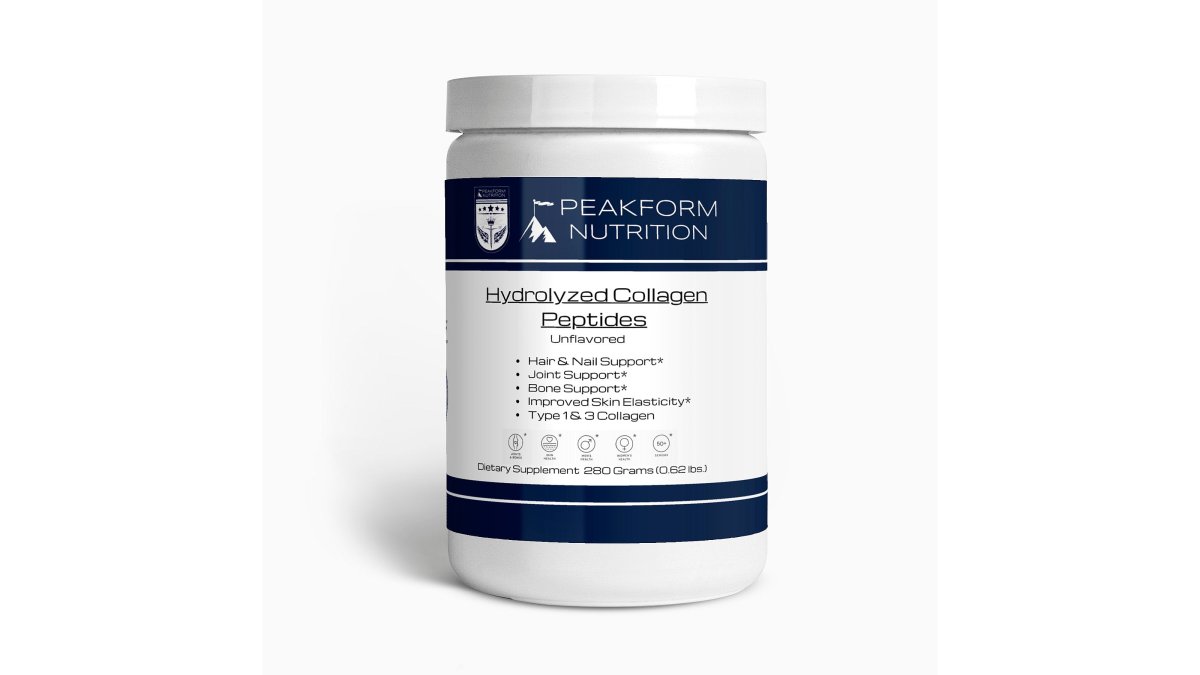
For most people, the best starting point is a plain hydrolyzed collagen peptide powder, because it delivers types 1 and 3 collagen without added sugar or stimulants. Peakform Nutrition's Grass-Fed Hydrolyzed Collagen Peptides is our top pick at $34.99, unflavored and easy to mix into cold beverages.
| Product | Format | Collagen Type | Price | Best For |
|---|---|---|---|---|
| Grass-Fed Hydrolyzed Collagen Peptides | Unflavored powder | Types 1 and 3 | $34.99 | Daily skin and joint support |
| Grass-Fed Collagen Peptides Powder (Chocolate) | Flavored powder | Types 1 and 3 | $34.99 | People who dislike plain powder |
| Grass-Fed Collagen Creamer (Vanilla) | Creamer powder | Types 1 and 3 | $34.99 | Coffee drinkers |
| Aphrodite's Blessing Anti-Aging Serum | Topical serum | Peptides plus retinol | $79.99 | Layering topical collagen support |
Pros and Cons at a Glance
Plain peptide powder wins on flexibility and cost per serving, but has no flavor and no built-in vitamin C. The chocolate and vanilla versions solve the taste problem at the same price, though they include added ingredients like cocoa and stevia. Topical serums work on a different layer of skin and complement, rather than replace, oral supplementation.

The Best Collagen Type for Skin Health
Type 1 collagen is the best collagen type for skin health, because it makes up the bulk of the dermis and provides most of the tensile strength skin relies on. Type 3 collagen is closely associated with type 1 in skin tissue, which is why most skin-focused supplements combine the two.
Type 2 collagen is built for cartilage and generally marketed for joint comfort. For skin firmness, a type 1 and 3 blend is the sensible choice. Peakform Nutrition's Grass-Fed Hydrolyzed Collagen Peptides contains types 1 and 3 from bovine hide, matching the profile most skin research focuses on.
How Long to Take Collagen for Skin Elasticity
The honest answer on how long to take collagen for skin elasticity is that most people should plan on eight to twelve weeks before judging results. Collagen turnover in the dermis is slow, and a supplement supports that turnover rather than forcing an overnight change.
A common approach is one serving daily for at least two months before deciding whether to continue; stopping after two weeks tells you almost nothing. For a fair test, pick a fixed daily time, take it with a beverage you already drink, and keep the routine identical throughout.
What the Clinical Evidence Says About Collagen and Skin Firmness
The clinical literature on oral collagen peptides is more specific than most reviews admit. The strongest trials share a design: randomized, double-blind, placebo-controlled, with a hydrolyzed peptide dose typically between 2.5 and 10 grams per day over 8 to 24 weeks. Outcomes are measured with instruments, not opinions, cutometer readings for skin elasticity (R2 and R5 parameters), corneometer readings for hydration, and standardized wrinkle-depth imaging. A reported change in "skin elasticity" usually means a numeric shift in one of those outputs, not a subject's impression in a mirror.
Meta-analyses pooling these trials generally report statistically significant improvements in skin hydration and elasticity versus placebo, with the largest and most consistent effects on hydration. Elasticity improvements tend to be smaller and more variable between studies. That variability is the story: formulas differ in peptide molecular weight, source (bovine, porcine, marine), dose, and whether vitamin C, hyaluronic acid, or biotin is co-formulated. A positive result for one peptide at one dose does not transfer automatically to a different product.
What the Evidence Actually Supports at 4, 8, and 12 Weeks
The trial data clusters into a predictable arc, and setting expectations against it is the most useful thing a reader can do before buying:
- Weeks 0-4: Hydration-focused changes are the first to appear in instrument data. This is largely a moisture-retention effect, not new collagen. If you are judging by feel, this is the stage where skin may seem less tight after cleansing.
- Weeks 4-8: Elasticity parameters begin to separate from placebo in several trials. This is the earliest window where a firmness change is plausible, and it is also where most people quit because the change is subtle.
- Weeks 8-12: The largest between-group differences in elasticity and wrinkle depth appear in trials that run this long. Twelve weeks is the most common endpoint in the published research, which is why it is the honest minimum for a fair self-test.
- Beyond 12 weeks: Evidence thins out. Few trials extend past six months, so claims about long-term remodeling are extrapolation, not data.
How to Read a Collagen Study Without Getting Fooled
The PubMed database of clinical trials is the most direct route to primary studies, and a few filters cut through most of the noise. Look for "randomized, double-blind, placebo-controlled" in the abstract. Check whether the outcome was an instrument measurement or a self-reported questionnaire, both have value, but they answer different questions. Check the dose and the peptide source, because a marine collagen trial does not validate a bovine product. And check who funded it: manufacturer-funded trials are common in this category and are not automatically invalid, but they warrant a closer look at the effect size.
The NIH Office of Dietary Supplements maintains plain-language guidance on supplement labeling and safety that is worth reading before you rely on any single study. No single trial, and no single meta-analysis, is strong enough to override the general pattern: modest, real, hydration-first effects that show up over months, not days.
Dosage, Synergistic Ingredients, and Absorption
Dose is the easiest variable to get right and the one most often gotten wrong. The literature clusters around 2.5 to 10 grams of hydrolyzed collagen peptides per day, taken consistently. There is no strong evidence that doses above 10 grams produce proportionally better skin outcomes, and clear evidence that inconsistent dosing produces nothing measurable. The practical target is the highest daily amount you will actually take for twelve weeks straight, for most people, one scoop, not three.
Why Hydrolyzed Peptides Absorb Differently
Bioavailability separates a real collagen product from a label that just says "collagen." Intact collagen is a large triple-helical protein the gut digests into individual amino acids before absorption.
The Co-Factors That Actually Matter
Reading a Label for Absorption Signals
Sourcing, Safety, and Side Effects
Conclusion
Frequently Asked Questions
Will collagen peptides tighten loose skin?
Collagen peptides can improve skin elasticity and firmness, but they will not fully tighten loose skin caused by significant weight loss or advanced aging. Clinical studies show measurable improvements in skin elasticity metrics after 8 to 12 weeks of daily oral supplementation. Hydrolyzed collagen provides the amino acids glycine, proline, and hydroxyproline that support fibroblast activity and collagen synthesis in the dermis. Results are gradual and best supported by consistent use alongside sun protection and adequate hydration.
How long does it take to see results from collagen peptides?
Most randomized controlled trials report visible changes in skin hydration and elasticity after 8 to 12 weeks of daily use. Some participants notice improved skin hydration within 4 weeks, but structural changes to the dermal matrix take longer. A realistic timeline for skin elasticity improvements is 3 to 6 months. Taking collagen peptides consistently at the recommended dosage matters more than which specific week you start seeing results.
Which collagen type is most effective for skin elasticity?
Type I and Type III collagen are the primary types found in skin, and hydrolyzed collagen peptides containing both are the most studied for skin elasticity. Type I provides structure to the dermis and epidermis, while Type III supports skin flexibility. Bovine hide collagen peptides naturally contain both types, which is why grass-fed hydrolyzed collagen is a common choice for skin health reviews.
Are there side effects to taking daily collagen supplements?
Collagen peptides are generally well tolerated. Some people report mild digestive discomfort, bloating, or a feeling of fullness when starting. These effects usually fade within a few days. Because most collagen peptides come from bovine or marine sources, anyone with related allergies should check the label. If you take prescription medication or have a medical condition, talk to your healthcare professional before starting a supplement regimen.