

Table of Contents
- What Clean Ingredients for Muscle Building Actually Means
- Clean Bulking vs. Dirty Bulking: The Ingredient Difference
- How to Read Supplement Labels for True Ingredient Transparency
- Third-Party Supplement Testing: Your Verification Standard
- Transparently Sourced Sports Supplements: What Sets Them Apart
- Plant-Based vs. Animal-Based Protein: Bioavailability and Muscle Growth
- The Complete Stack: Building Lean Muscle with Clean Ingredients
- Frequently Asked Questions
Last Updated: October 2, 2026
What Clean Ingredients for Muscle Building Actually Means
Clean ingredients for muscle building refers to supplements and whole foods formulated without artificial additives, synthetic fillers, or unnecessary processing that could compromise your muscle growth or overall health. At Peakform Nutrition, we define clean as transparent sourcing, minimal ingredient lists, and products backed by ingredient verification, not marketing claims alone.

Clean ingredients maximize bioavailability and amino acid profiles that support muscle protein synthesis, while eliminating compounds causing bloating, digestive distress, or metabolic stress. They combine three elements: transparent sourcing, scientific efficacy, and minimal processing.
Clean Bulking vs. Dirty Bulking: The Ingredient Difference
Clean bulking prioritizes nutrient-dense calories with minimal inflammatory compounds, while dirty bulking accepts any caloric surplus regardless of ingredient quality. The ingredient difference directly affects lean muscle growth versus fat accumulation.
Clean bulking emphasizes whole food sources, complex carbohydrates, and complete-protein supplements. Pre-workouts contain nootropics for mental clarity without excessive caffeine. Post-workout recovery includes digestive enzymes that improve amino acid bioavailability and reduce bloating.
Dirty bulking relies on processed carbs, high-sugar formulas, and incomplete proteins. You gain weight faster, but more becomes fat. Artificial sweeteners and fillers create metabolic stress that diverts energy from muscle hypertrophy.
How to Read Supplement Labels for True Ingredient Transparency
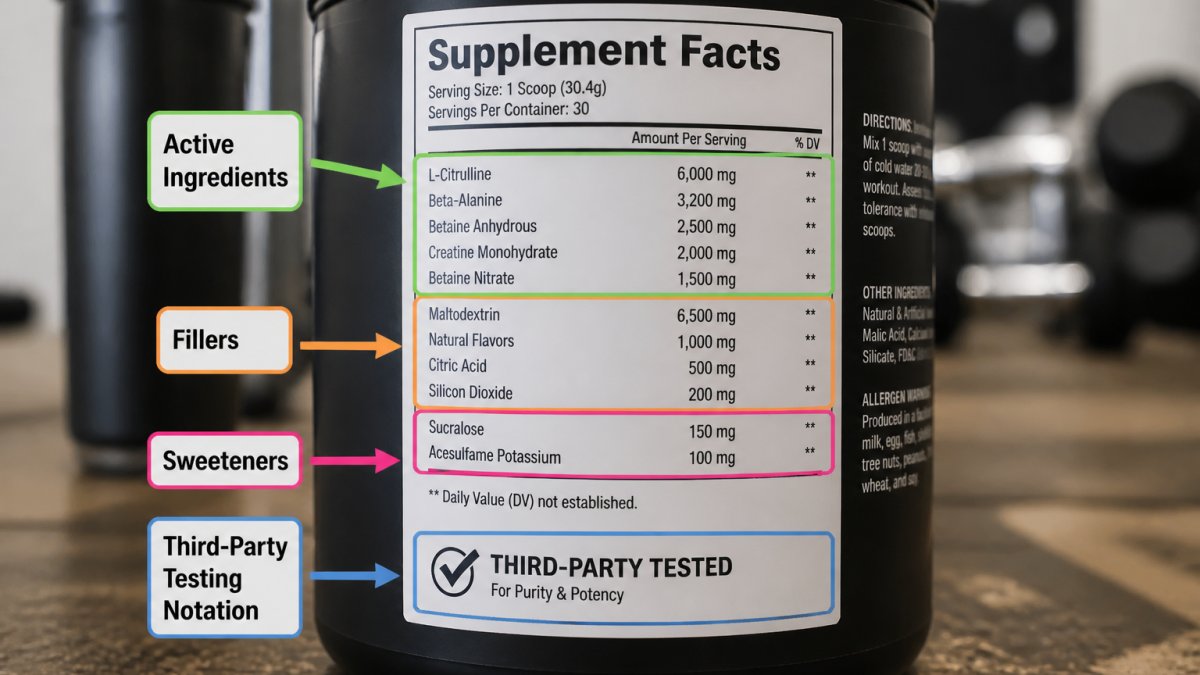
Reading supplement labels correctly defends against misleading marketing. The real information lives in the Supplement Facts panel and fine print.
Start with the active ingredient amounts. The Supplement Facts panel must list each active ingredient in milligrams or grams. "Proprietary blend" without individual amounts hides dosages, a 2,000 mg blend could contain only 100 mg of active ingredient.
Identify fillers and flow agents. Silicon dioxide, magnesium stearate, and microcrystalline cellulose serve no nutritional purpose and represent wasted space. Fewer than 12 ingredients suggests focused formulation; more than 20 indicates unnecessary padding.
Check ingredient order and source specificity. The first three ingredients represent approximately 80% of the product. If sugar or maltodextrin appears in the top three of a protein powder, you're buying a carbohydrate product.
Scan for artificial sweeteners and their amounts. The Supplement Facts panel should disclose sweetening agents. If a label claims "zero sugar" without disclosing the sweetener, that's incomplete transparency.
Look for third-party testing notation. This is the most important transparency indicator. "NSF Certified for Sport," "USP Verified," or "Informed Choice Certified" mean an independent laboratory verified label accuracy and tested for banned substances. Without this notation, you're trusting only manufacturer's internal control.
Check the allergen statement and facility disclosures. Manufacturers must disclose allergens and cross-contamination risks. Transparent manufacturers list these because they've verified their process.
Verify the expiration date and batch number. Clear printing allows traceability for contamination or recall. Tiny fonts or missing batch numbers signal the manufacturer doesn't prioritize traceability.
Third-Party Supplement Testing: Your Verification Standard
Third-party testing objectively verifies whether a supplement contains what the label claims. NSF Certified for Sport is most rigorous for athletes, screening for over 270 banned substances and testing for heavy metals and microbial contamination. USP Verified confirms purity, potency, and manufacturing quality. Informed Choice focuses on banned substance testing for competitive athletes.
NSF or USP on a label means you're paying for verification, not marketing.
Transparently Sourced Sports Supplements: What Sets Them Apart
Transparent sourcing discloses ingredient origin, processing, and third-party testing. Labels should list country of origin, specify whether ingredients are synthesized or natural, and document testing for heavy metals, pesticides, and microbial contamination. This information should be publicly available. You're paying for verification, not marketing.
Plant-Based vs. Animal-Based Protein: Bioavailability and Muscle Growth
The choice between plant-based and animal-based protein fundamentally affects how much muscle you build per gram of protein consumed. This isn't a marketing distinction, it's rooted in amino acid composition and how your body processes each source.
Understanding the amino acid profile difference. Animal-based proteins (whey, casein, beef isolate) contain all nine essential amino acids in amounts that match human requirements.
Why leucine matters mechanistically. Leucine activates mTORC1, a cellular signaling pathway that initiates muscle protein synthesis (pubmed.ncbi.nlm.nih.gov).
Measuring bioavailability: PDCAAS and DIAAS scores. Protein Digestibility Corrected Amino Acid Score (PDCAAS) rates how completely your body can digest and absorb a protein source.
Combining plant proteins for completeness. A single plant source is incomplete, but strategic combinations create a complete amino acid profile. Pea + rice is a classic pairing: pea is high in lysine (where rice is low) and rice is high in methionine (where pea is low). When evaluating a plant-based protein blend, check the label for total leucine content.
Absorption speed and timing implications.
For muscle building, post-workout timing matters. A rapidly absorbed complete protein (whey) maximizes the muscle protein synthesis window when your body is most responsive to amino acids.
Practical considerations for clean ingredients. Animal-based proteins often come from dairy or beef, which can trigger bloating or digestive distress in sensitive athletes. Whey isolate removes most lactose, reducing this issue. Plant-based proteins generally cause less bloating because they lack dairy.
For clean ingredients for muscle building, the choice depends on your tolerance and goals. If you tolerate dairy well and prioritize maximum muscle growth per serving, whey isolate or casein offers superior bioavailability and leucine content.
Neither source is inherently "cleaner." Transparency and third-party testing matter more than the source. A clean plant-based protein with NSF certification and disclosed amino acid profiles is preferable to an unverified animal-based protein with hidden fillers.
The Complete Stack: Building Lean Muscle with Clean Ingredients
A complete clean muscle-building stack combines four categories: protein for amino acid synthesis, complex carbohydrates for sustained energy, micronutrients for metabolic support, and performance compounds that enhance training quality.
Protein foundation: Start with whey isolate or a complete plant blend. Aim for 25-30 grams post-workout, 20 grams with meals. The Peakform Nutrition Workout Basics Bundle ($135.99) includes Elite Standard Whey for post-workout recovery with a complete amino acid profile designed to support muscle protein synthesis without unnecessary fillers.
Carbohydrate timing: Consume complex carbs (oats, rice, sweet potato) around training. Avoid simple sugars that spike insulin without sustained energy. A 2:1 carb-to-protein ratio post-workout optimizes recovery by replenishing glycogen while amino acids rebuild muscle tissue.
Micronutrient support: A quality multivitamin fills gaps in whole food nutrition. The [Peakform Nutrition Multivitamin Gummies (Adult)](https://peakformsupplements.com/products/peakform-nutrition-multivitamin-gummies-adult) ($24.99) provides essential vitamins and minerals that support metabolic health and muscle recovery without artificial sweeteners or synthetic fillers.

Performance enhancement: Pre-workout formulas should deliver sustained energy without jitters. Ambrosia Pre-Workout ($64.99) combines nootropics for mental clarity with nitric oxide precursors for blood flow and reduced muscle fatigue, prioritizing clean energy and avoiding the crash that undermines training quality.
Stack these strategically: pre-workout 30 minutes before training, post-workout protein and carbs within 60 minutes, daily multivitamin with breakfast, and whole food protein at each meal.
Building lean muscle requires more than hard training, it demands clean ingredients for muscle building that support your body's recovery and growth mechanisms. The difference between transparent sourcing, third-party testing, and ingredient transparency is the difference between gaining lean muscle versus gaining weight that's fat because your supplement stack contains fillers and artificial compounds that compromise nutrient partitioning.
Start by evaluating your current supplements against the transparency standards we've covered: complete ingredient lists, third-party testing notation, and documented sourcing. Then transition to a clean stack that prioritizes bioavailability and metabolic support. Peakform Nutrition's approach to clean ingredients for muscle building combines all three elements, transparent sourcing, third-party verification, and formulas designed around the science of muscle protein synthesis rather than marketing claims. Shop Now and experience the difference clean ingredients make in your training results.
Frequently Asked Questions
What are the most effective clean ingredients for muscle growth?
The top clean ingredients for muscle growth include whey protein isolate (for complete amino acid profile and bioavailability), creatine monohydrate (proven to increase lean muscle mass and strength), beta-alanine (reduces muscle fatigue), and citrulline malate (enhances blood flow and nutrient delivery). Plant-based options like pea protein and hemp seed offer good amino acid profiles. Look for products listing these by their full names rather than proprietary blends that hide exact amounts.
How do third-party certifications verify supplement purity?
Third-party testing organizations like NSF Certified for Sport, Informed Choice, and USP verify that supplements contain exactly what the label claims and are free from banned substances, heavy metals, and microbial contaminants. These labs independently test finished products against strict standards, then allow brands to display certification seals. This matters because the supplement industry is less regulated than pharmaceuticals, third-party testing fills that gap and gives you proof the product is actually clean.
What should I avoid when looking for clean muscle-building supplements?
Avoid artificial sweeteners like sucralose and aspartame if you're sensitive to them, as they can trigger bloating and gastrointestinal distress in some athletes. Skip proprietary blends that hide exact ingredient amounts, you can't verify if you're getting therapeutic doses. Watch for added fillers, silica, and magnesium stearate. Steer clear of products making disease claims or lacking ingredient sourcing information. Finally, avoid mass gainers loaded with simple sugars unless you're specifically doing a caloric surplus for bulking.
Is there a real difference between clean bulking and dirty bulking ingredients?
Yes. Clean bulking uses whole food nutrition and supplements with transparent, nutrient-dense ingredients to support a controlled caloric surplus for lean muscle growth. Dirty bulking relies on high-calorie processed foods and supplements heavy in sugar and artificial additives, which create excess fat gain alongside muscle. Clean bulking ingredients emphasize macronutrient balance, complex carbohydrates, and micronutrient density to support muscle hypertrophy without unnecessary inflammation or metabolic stress. The difference directly affects body composition and recovery quality.